

Consumers bring a complex mix of emotion, risk-aversion, and deeply personal values to the table. By using the hospital selection process as a blueprint, we can demonstrate how a rigorous blend of qualitative laddering and quantitative MaxDiff analysis transforms abstract human needs into formulated claims that win.
To create messaging and claims that truly resonate with patients, organizations need to understand not just what matters to people, but why it matters. That’s where a combined qualitative-first, quantitative-second research approach can make all the difference.
Understanding The Emotional Drivers Behind The Selection Process—A Qualitative Approach
Qualitative research plays a critical role in uncovering the emotional drivers behind patient decisions and experiences. Two techniques are especially powerful in this early phase: laddering and emotional journey mapping.
Laddering is a qualitative interviewing technique designed to uncover why a specific attribute matters. By repeatedly asking questions like, “Why is that important to you?”, researchers move from functional features to emotional benefits and core values.
For example:
- Step One: By using advanced technology, I know I will survive critical surgery.
- Step Two: It makes me feel safe.
- Step Three: It gives me confidence that I will be healthy soon.
What starts as a technical feature becomes an emotional promise. This insight helps organizations move beyond feature-based claims and toward messages that resonate on a human level.
Emotional journey mapping examines how feelings shift across key stages of the patient's experiences such as researching options, receiving treatment, and recovery. For example, a claim like, “Short distance from my home” may seem purely practical, but mapped across the journey, it takes on deeper meaning:
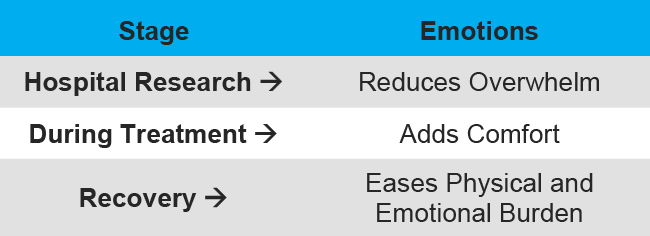
This technique reveals when certain claims will matter most, helping organizations tailor messages to specific moments in the journey.
Turning Qualitative Insights into Stronger Claims
Insights from laddering and emotional journey mapping are then synthesized into a set of emotionally grounded claims—using language that reflects how patients actually think and feel.
Here’s how basic functional claims can be elevated:
- Is not crowded → Care that feels attentive, not rushed
- Uses the latest medical technology → Advanced technology you can trust when it matters most
- Short distance from my home → Care that’s close when you need it most
- Specializes in treating a disease → Expert care focused on your specific condition
- Accepts my insurance → Care you can access without financial stress
These claims retain their functional truth but are reframed around emotional benefits—making them stronger candidates for quantitative testing.
Prioritizing What Drives Hospital Selection—A Quantitative Approach
Next, the statements should be tested quantitatively. The research method, MaxDiff, can be used to discover the factors or elements patients prioritize when selecting a hospital. It does this by asking respondents to compare-and-contrast, choosing between the Most Important and the Least Important factors.
For Example:
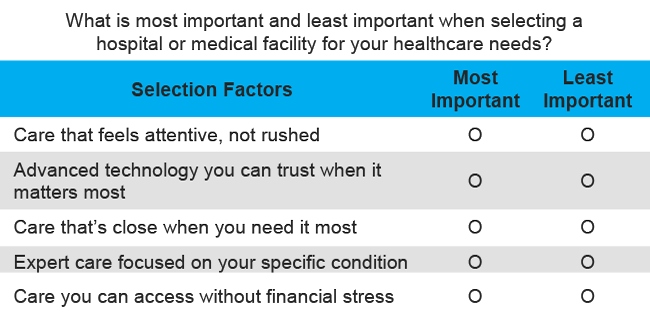
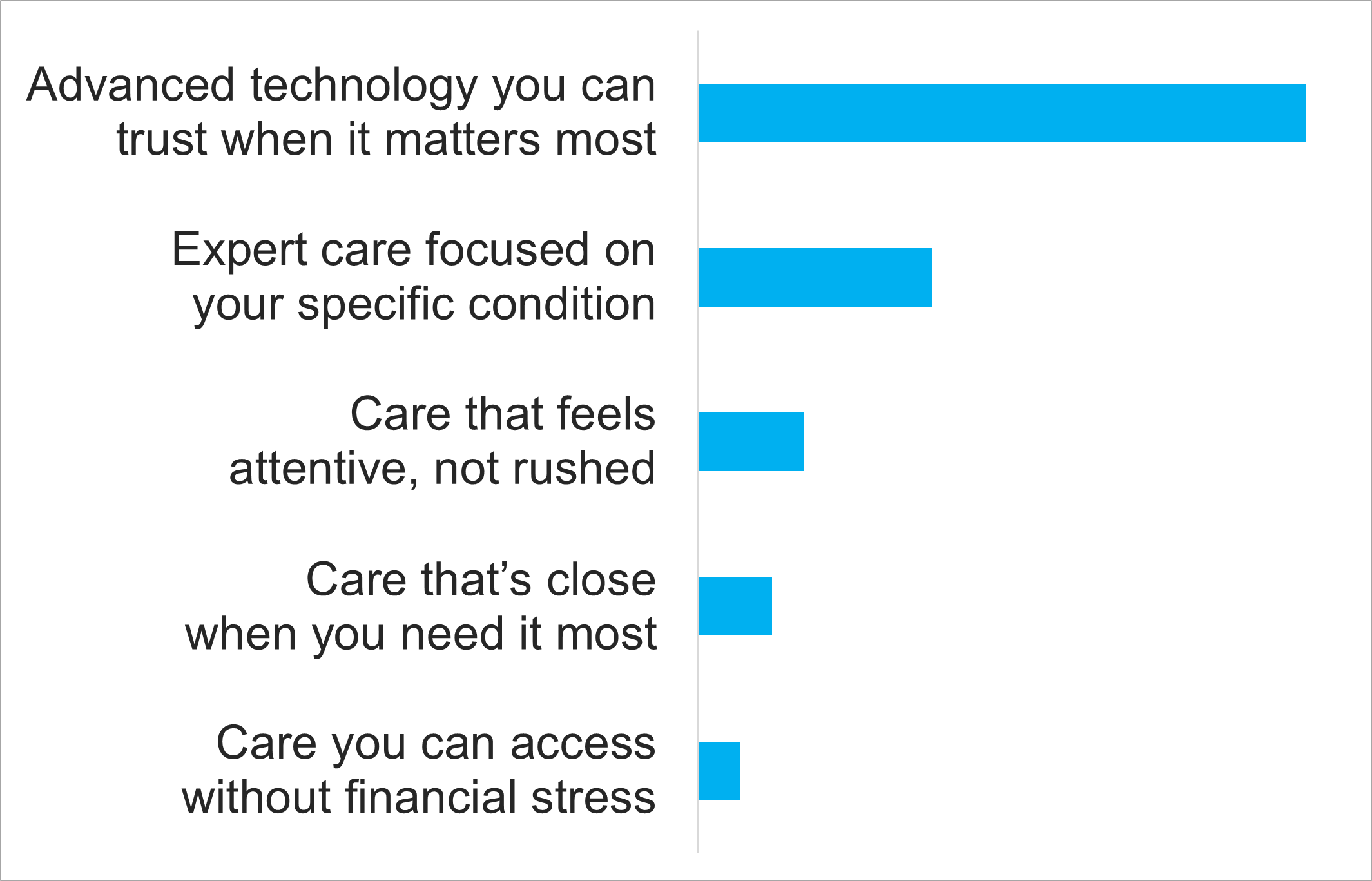
The analysis creates a ranking list of the most important to the least important factors when selecting a hospital or medical facility.
Helping Patients By Communicating Effectively
Starting with qualitative research ensures claims are authentic, emotionally resonant, and rooted in real patient experiences. Following with MaxDiff provides the rigor needed to prioritize those claims with confidence.
In healthcare, effective communication isn’t about saying more, it’s about saying the right things, informed by human insight and supported by data.
Our analytics and qualitative insights experts are uniquely equipped to reach these results by way of these methodologies. They can help identify how and why patients select a hospital or medical facility over another.
Author

Stephanie Trevino
Research Director
Stephanie has nearly 15 years of experience in the marketing research field. She is skilled in both qualitative and quantitative research for both consumer and B2B segments. Her experience includes panel and respondent management, project management, data quality assurance, questionnaire design, reporting, and data visualization. Stephanie holds a Bachelor of Arts from Texas State University and a Master of Business Administration from the University of Texas at Arlington.
Qualitative Team Lead

Clay Dethloff
Senior VP, Insights and Innovation
Clay is an experienced marketing research professional with more than 25 years of experience in both leading and delivering qualitative research in the industry. As the head of qualitative research efforts at Decision Analyst, Clay is responsible for maintaining and improving the quality of qualitative research, identifying new/innovative qualitative research tools, and overall management of the qualitative team.
Advanced Analytics Team Lead

Elizabeth Horn
Senior VP, Advanced Analytics
Beth has provided expertise and high-end analytics for Decision Analyst for over 25 years. She is responsible for design, analyses, and insights derived from discrete choice models; MaxDiff analysis; volumetric forecasting; predictive modeling; GIS analysis; and market segmentation. She regularly consults with clients regarding best practices in research methodology. Beth earned a Ph.D. and a Master of Science in Experimental Psychology with emphasis on psychological principles, research methods, and statistics from Texas Christian University in Fort Worth, TX.
Copyright © 2026 by Decision Analyst, Inc.
This posting may not be copied, published, or used in any way without written permission of Decision Analyst.